
Job adverts are meant to attract talent, but often they end up filtering candidates out. Those who focus primarily on job titles, qualifications and years of experience when conducting recruitment unnecessarily limit their talent pool. Skills-based recruitment therefore places the actual work at the centre: what tasks need to be carried out and what skills are essential for them?
Recruitment is central to a company’s success. It ensures that the right people fill the right roles. Every vacancy incurs costs; every poor hire ties up resources and can impair team performance. At the same time, many companies face the challenge of filling vacancies more quickly and sustainably in a tight labour market. This makes it all the more important to design recruitment processes in a way that achieves the greatest possible impact with a reasonable level of effort. This raises a key question: are we actually focusing on the criteria that determine a role’s success?
What Is Skills-Based Recruitment?
A skills-based approach breaks roles down into specific skills and tasks. The focus is on what a person can achieve or learn. The aim is to highlight the actual success factors of a role and to assess the fit between the role and the individual more precisely.
Meaningful Job Profiles – A Focus on Skills Rather Than Qualifications
The difference between a traditional and a skills-based job profile is most evident in the language used. While traditional requirement profiles often demand evidence of qualifications, skills-based profiles describe specific tasks, skills and outcomes.
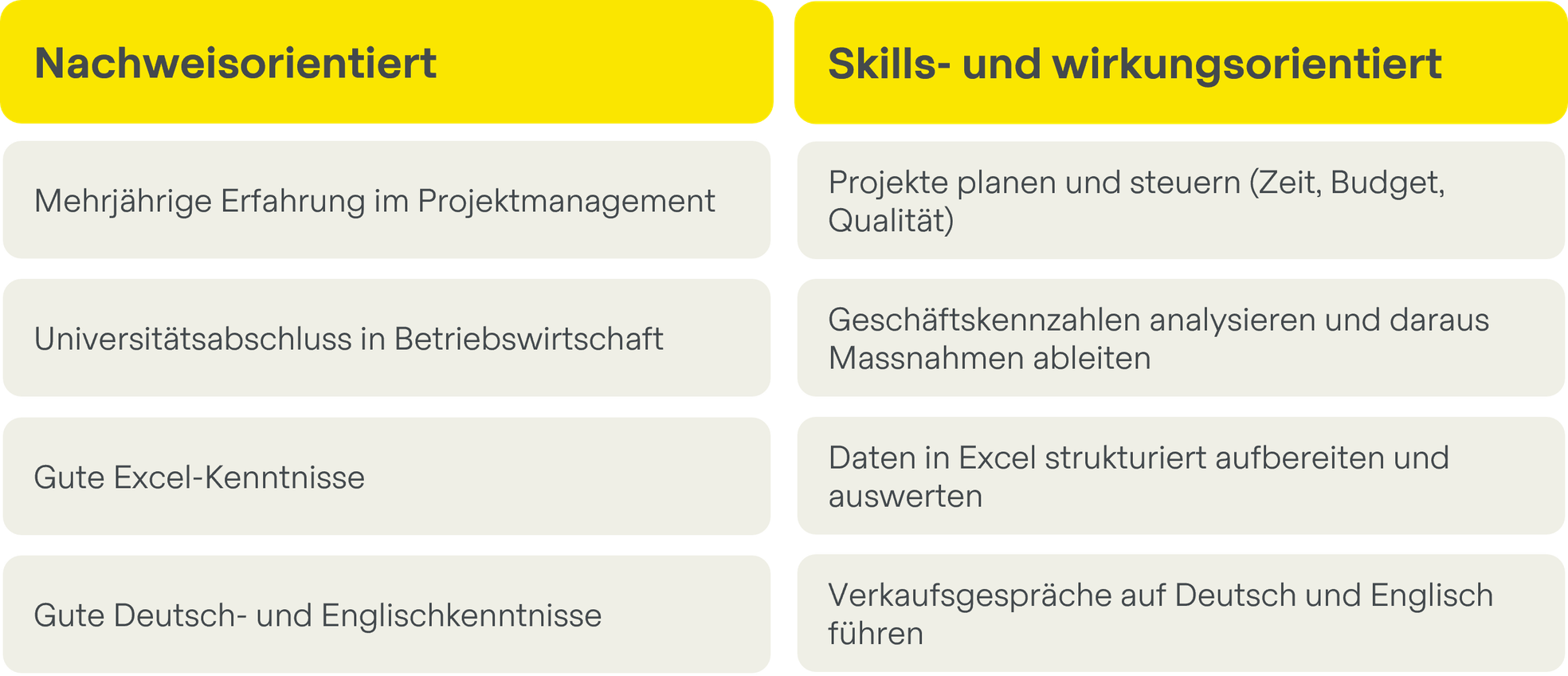
The shift in perspective is simple: what matters is not what someone can prove, but what someone can contribute:
•Instead of asking about tool knowledge, we ask: «What results do you achieve using that tool?»
• Instead of «What training have you had?», we ask: «What problems can you solve?»
• Instead of «knowledge of a tool», we ask: «What results do you achieve using that tool?»
Reaching More Talent – Focusing on Skills and the Future Rather Than Titles and the Past
Role- and qualification-based job adverts often filter out potential talent before they even apply. Those who place a strong emphasis on job titles, qualifications or linear career paths unnecessarily limit the pool of applicants. People with the right skills are overlooked – not because they are unsuitable, but because their career history does not fit the traditional mould.
Skills-based recruitment flips the perspective: the focus is on specific tasks. Requirements are translated into specific tasks, making them easier for applicants to understand. Skills-based recruitment does not merely assess a person’s career to date. Equally important is the question of what skills a person can acquire in the future. Alongside the question ‘What have you done so far?’, the focus therefore also shifts to ‘What can you learn?’ and ‘How do you intend to develop further?’. This is particularly crucial in a dynamic working environment, as it is not only existing competencies that count, but also the ability to develop new skills. As a result, more people who possess the relevant skills feel drawn to apply – regardless of where they acquired them.
This is particularly relevant for:
- People whose skills have been developed primarily through practical experience
- Career changers
- People with non-linear career paths
- Specialists from related fields
By focusing on actual skills, the talent pool can be broadened in a targeted way and previously untapped potential can be unlocked.
More Precise Requirements – More Informed Decisions
The shift to skills-based recruitment does not begin with the candidates, but with the role itself. Tasks, responsibilities and the skills required for them must be clearly defined. Instead of defining roles primarily by job titles, qualifications or years of experience, they are described in terms of specific activities, competencies and expected outcomes.
This also changes the role of recruiters. They increasingly act as sparring partners for the specialist departments, helping to identify the actual requirements of a position. The focus is no longer on the ‘right CV’, but on the question of who possesses the necessary skills or has the potential to develop them.
AI can play a supporting role – particularly in analysing job profiles, matching skills and carrying out structured pre-selection of applications. This makes it possible to identify initial matches more efficiently.
The additional effort is required primarily at the outset, when defining the requirements. However, the benefits are evident in the quality of the decisions. Instead of focusing primarily on formal criteria, greater emphasis is placed on the actual contribution to the role – both now and in the future.
In the long term, this leads to:
- more informed selection decisions
- a better assessment of potential
- greater accuracy in matching candidates to roles
- fewer mis-hires
- more stable teams
Investing in more precise job profiles often pays off only in the longer term. More sustainable hiring decisions and fewer mis-hires reduce follow-on costs in the long run and increase the effectiveness of the recruitment process.
Conclusion: Fewer Filters, Greater Impact
Skills-based recruitment is not a cost-cutting measure for the recruitment process. It is a way to improve quality. Those who invest in clear job profiles and structured selection processes make more informed staffing decisions. This broadens the talent pool, reduces unnecessary hurdles and increases the chance of attracting people who can make a contribution both now and in the future.
Author

Rebekka Bitschnau
SAP SuccessFactors, Consulting Strategies
Rebekka supports HR teams in making their talent management clear, efficient and effective. She makes targeted use of technical solutions to make processes more transparent and create real added value for organisations. In doing so, she always thinks one step ahead. In addition to operational implementation, she also supports HR at a strategic level, aligning HR objectives with the organisation’s requirements. Her focus remains clear: to develop solutions that drive organisations forward whilst keeping the people within the organisation at the centre of everything.
HR Knowledge
In our download portal you will find useful fact sheets, helpful checklists and supporting information for you and your HR team to download.