
Working from home has long since evolved from a short-term crisis measure into an integral part of modern working environments. Many employees now expect flexible working arrangements that enable them to work productively regardless of their location. At the same time, companies face the challenge of reconciling these expectations with their corporate culture, leadership and Technology.
It is becoming clear that successful remote working requires more than just a laptop and digital meetings. Clear guidelines, suitable digital solutions and a corporate culture based on trust and personal responsibility are crucial.
Working from Home: Social, Environmental and Economic
Working from home brings benefits for both employees and companies alike. Reduced commuting time lowers stress levels and saves time in everyday life. At the same time, CO₂ emissions are reduced as commutes are eliminated, and companies can make more efficient use of office space.
According to a study by the digitalswitzerland location initiative, around 67,000 tonnes of CO₂ could be saved annually if 450,000 workers in Switzerland were to work from home one day a week. Further savings result from reduced business travel and digital meetings. Recent surveys also show that flexible working arrangements are well established in Switzerland. According to the FHNW’s FlexWork Trend Study 2024, 41 per cent of the working population regularly work from any location and regard the flexibility this brings as a key factor in their satisfaction and productivity.
Productivity is also trending positively in many cases. Various studies show that employees working from home are often more focused and enjoy greater autonomy in organising their daily work routine. The Microsoft Work Trend Index also shows that flexible working models are now among the most important expectations that many employees have of modern employers. At the same time, the option to work from home is increasingly becoming a key factor for many employees when choosing an employer.
Focus on Employee Wellbeing
Despite its many advantages, working from home does not work equally well for everyone. A lack of face-to-face interaction, blurred boundaries between work and leisure, or distractions at home can present challenges. It is therefore important to regularly assess employees’ needs and facilitate flexible solutions within Teams.
Employee surveys help companies to identify challenges at an early stage and devise targeted measures. At the same time, managers are needed who build trust, communicate openly and actively support their Teams, even when they are working from home.
From projects with Swiss companies, we know that the technical infrastructure for working from home is often already in place. The greatest challenges usually lie in collaboration, communication and the management of distributed Teams. Successful organisations set clear expectations, encourage regular dialogue and provide targeted support to managers in managing hybrid working arrangements. Last but not least, face-to-face interaction remains important. Creative workshops, strategic discussions and team activities continue to benefit from shared in-office time. Successful companies therefore strike a balance between flexibility and on-site collaboration.
At the same time, companies must also take organisational and legal aspects into account. Data protection, secure access to company data and compliance with working time regulations remain key issues when working from home. If employees are working temporarily from abroad, issues relating to tax, social security or employment law may also arise. Clear guidelines and transparent processes help to minimise risks at an early stage.
From Working from Home to Flexible Working Models
Whilst working from home originally referred primarily to working from one’s own home, flexible working models now go much further. Employees are increasingly working independently of location – for example, whilst travelling, in co-working spaces or, temporarily, from abroad.
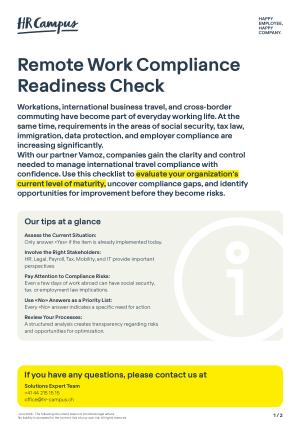
This places new demands on companies. Alongside technological requirements, issues such as data protection, compliance, social security and international labour regulations are becoming increasingly important. Clear processes and guidelines are crucial, particularly for « Remote work » arrangements abroad or « Workation » models.
Remote work abroad, in particular, can quickly give rise to complex requirements regarding tax, social security and compliance. Companies therefore need transparency regarding employees’ locations, lengths of stay and potential risks. The « Vamoz software » helps companies to manage international work assignments in a structured manner and to keep track of regulatory requirements at an early stage.
Technology as the Foundation for Successful Collaboration
Digital processes form the basis for a well-functioning home office. Collaboration tools, digital signatures, cloud solutions and modern HR platforms facilitate collaboration and create efficient processes for employees and managers.
Issues such as digital document workflows, absence management and secure access to company data are also becoming increasingly important. Companies that digitise their internal processes create better long-term conditions for flexible working and hybrid collaboration.
Conclusion
Working from home has long since become more than just a short-term trend. Flexible working models are now part of modern working life for many organisations and employees. Organisations that strategically promote working from home whilst simultaneously developing their culture, leadership and Technology strengthen their appeal as an employer, increase employee satisfaction and lay the foundations for long-term success.
Author

Johannes Lehoski
UKG pro WFM
Johannes specialises in digitalisation, HR processes and workforce management in the healthcare sector. In his work, he helps organisations simplify administrative processes for frontline teams and strengthen staff commitment through better planning, communication and leadership.
Sources
- Federal Statistical Office, Remote working
- FHNW, FlexWork Trend Study 2024: Mobile working and New Work in Switzerland
- Microsoft, Work Trend Index Annual Report 2026
- DigitalSwitzerland, Smart and green – digital pathways to net zero
HR Knowledge
In our download portal you will find useful fact sheets, helpful checklists and supporting information for you and your HR team to download.