
In the event of illness, the employer must continue to pay the employee’s salary for a specific time pursuant to Article 324a of the Swiss Code of Obligations (CO). This statutory continued payment of salary also applies in the event of an accident, when fulfilling statutory obligations or in the exercise of public office. The following remarks are limited to the obligation to continue paying salary in the event of illness.
Conditions for the continued payment of salary in the event of illness
a) General points
One condition for the obligation to continue paying salary in the event of illness is that the incapacity for work arose through no fault of the employee. In addition, the employment relationship must have lasted or been entered into for more than three months. Salary shall continue to be paid only if the reason for the absence lies “in the person of the employee” and occurred through no fault of their own.
b) What does “in the person of the employee” mean, as opposed to objective grounds for an absence?
It means that there is a personal impediment on the part of the employee that prevents them from attending work. By way of example, Article 324a CO explicitly mentions illness. However, the list provided in this Article is not exhaustive, and other impediments that affect the individual employee personally would therefore also be conceivable.
No continued salary payment shall be owed pursuant to Article 324a CO in the event of objective impediments, such as environmental disasters, border closures, flight cancellations or power cuts. These events do not constitute reasons that lie “in the person”, which means that one of the conditions for continued payment of salary under the CO is not met.
In the current geopolitical situation (the Middle East conflict), this is the exact issue that is likely to arise among parties to an employment contract. For example, Dubai, a popular holiday destination, closes the airport and employees find themselves stranded there. Or employees are travelling on business for an employer in this region and are now unable to fly back, or their flights are delayed. Does the employer have to pay the salary for the days of absence? A distinction must be made as to whether it is a private or a business trip.
- In the former case, the employee is generally able to work but is unable to fly back and perform the work at the workplace. In this case, the principle of “no work, no pay” applies. The employer is not responsible for the cancellation of flights or the closure of airports etc. For this reason, there is generally no entitlement to continued payment of salary for being prevented from working. In practice, such situations are often dealt with in a flexible manner in that the employer voluntarily pays for the days of absence, or a part thereof, with part covered by the employee at their own expense (additional holidays, compensation of overtime or unpaid holiday).
- A different picture emerges in the event of a business trip. In this case, the event falls within the employer’s sphere of risk. If the return journey cannot proceed as planned due to the current situation and work is temporarily impossible, the salary continues to be owed. Under certain circumstances, the employer could request that work be carried out remotely, provided the necessary infrastructure is available (when it comes to the internet, this is currently not the case everywhere).
A pragmatic solution seems sensible in such extreme situations.
c) Absence of fault
An employee is at fault if they intentionally caused their inability to work, or have at least accepted the possibility that this may occur. As far as the absence of fault is concerned, the bar is not particularly high where it comes to illness. Among legal scholars, self-mutilation or driving while drunk are quoted as examples of an employee being at fault. In the event of illness, the initial assumption is that the employee was absent through not fault of their own. According to case law, great restraint must be exercised before assuming that employees were at fault.
d) Duration of the employment relationship
An employee has no salary entitlement in the event of incapacity for work in the first three months of a permanent employment relationship. There is no obligation to continue paying salary under the CO, even in the case of short fixed-term employment contracts concluded for a term of less than three months. In other words: In the case of fixed-term employment relationships entered into with a term of more than three months, the obligation to continue paying salary applies from the first day of work. In the case of permanent employment relationships, the statutory continued payment of salary does not commence until the first day of the fourth month.
Please note that things are different if daily sickness allowance insurance has been taken out (see below).
e) Duration of continued payment of salary
If an employer has not taken out daily sickness allowance insurance, the obligation to continue paying salary pursuant to Article 324a CO applies. Pursuant to Article 324a(2) CO, the employer must continue paying salary for three weeks in the first year of service and for a reasonable period thereafter. The duration of the obligation to continue paying salary in the event of illness is based on years of service. As the CO only governs what must be paid in the first year of service, legal practice has developed what are known as the Zurich, Bern and Basel scales. The parties are free to decide which scale to apply. It is advisable to specify in the employment contract which scale shall be applied.
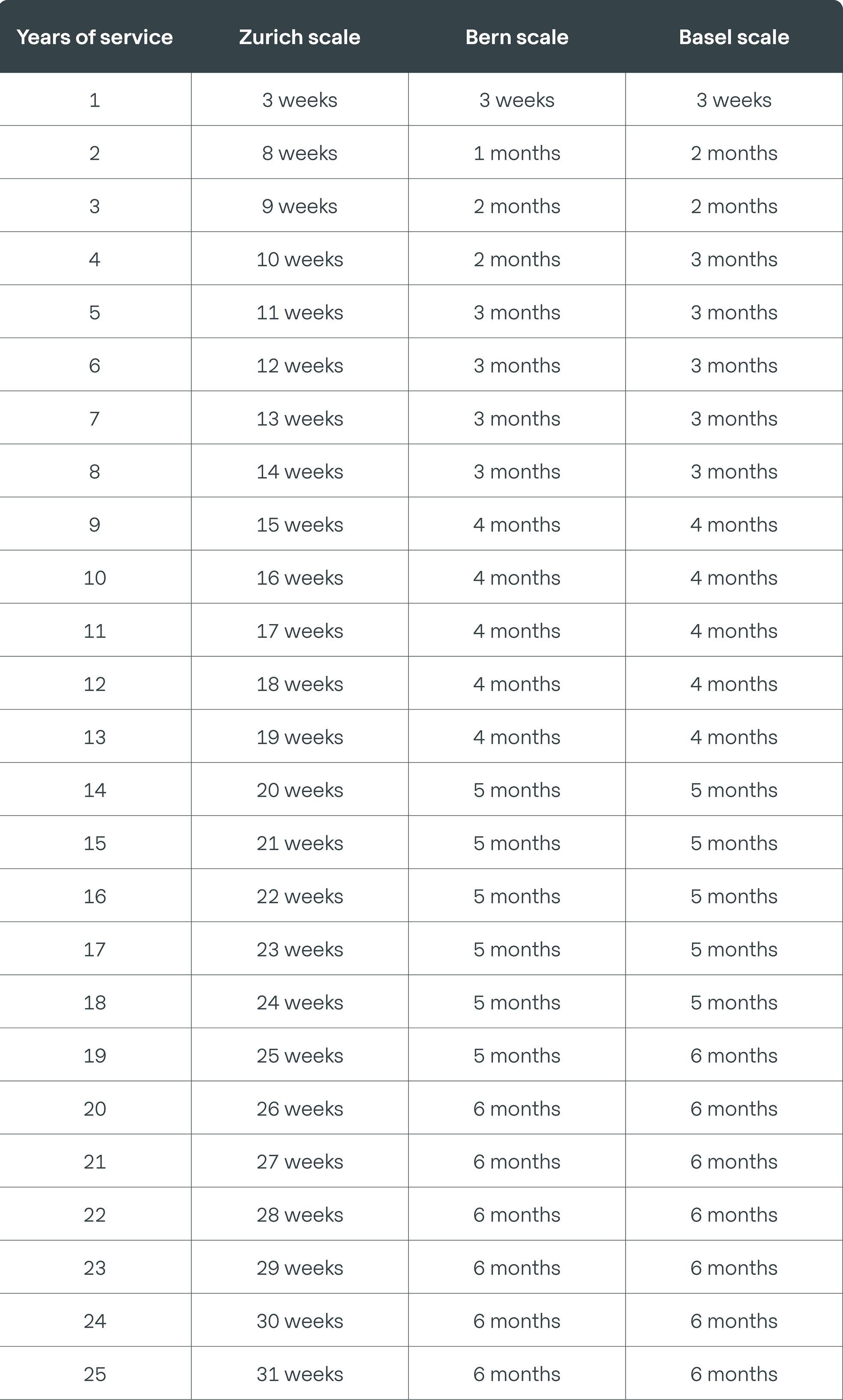
It is important to know that an entitlement to continued salary payment in the event of illness usually arises per year of service (in certain cases, courts have decided differently). This means that the obligation to continue paying salary generally starts again for each new year of service; the duration is based on the above scales. The entitlement therefore does not arise per case of illness but overall in relation to one year of service. Various absences that result in incapacity for work are added up.
f) Amount of continued salary
For the duration of the illness, the basic salary plus all salary components are payable. Employers may use the following yardstick: what would the employee have earned if they had worked (principle of loss of earnings)? This is the amount owed to the employee. Voluntary payments made by the employer are not taken into account.
This means that the basic salary must be paid, in addition to all salary components. Any payments in kind must also be made, insofar as they cannot continue to be provided in kind. Holiday pay and all extra pay, such as for inflation, night shifts, Sunday work, shift allowances and social contributions, must also be paid. In short: the salary should be the same as if the employee had worked.
Alternative: Daily sickness allowance insurance
A different arrangement may be agreed in the employment contract by way of written agreement, standard employment contract (SEC) or collective employment contract (CEC). This means that, in lieu of the statutory continued salary payment pursuant to Article 324a CO, the employer is free to take out voluntary daily sickness allowance insurance, which covers the consequences of incapacity for work due to illness. Daily sickness allowance insurance is only mandatory if provided for in an SEC or CEC. Medium-sized and larger companies regularly take out voluntary daily sickness allowance insurance, but there are companies that do not provide such an alternative solution.
When taking out daily sickness allowance insurance, care must be taken to ensure that it is equivalent to the statutory solution. According to the Federal Supreme Court, this applies in particular where the benefits are structured as follows: The insurance covers 80% of the salary over a period of 720 days within 900 days, with a maximum waiting period of 2–3 days. In addition, at least 50% of the premium for daily sickness allowance insurance must be borne by the employer. Even if only 80% of the salary is paid under this scheme, the courts consider such a solution to be equivalent, given that the overall duration of the benefits is longer. In the event of a dispute, the courts will decide whether a daily sickness allowance solution is equivalent. It therefore makes sense to proceed with the equivalent solution approved by the Federal Supreme Court as a minimal solution and to refrain from experimenting with alternatives, thereby risking that, in the event of a dispute, the insurance solution will be deemed not to be equivalent.
If an equivalent daily sickness allowance solution exists, the employer need not make its own payment during the employee’s absence due to illness, unless the daily sickness allowance insurance pays after a contractually agreed waiting period of, for example, 30 or 60 days. During the waiting period, the employer must pay the salary. In practice, employers often pay 100% during the waiting period, and the benefits paid in lieu of salary are only reduced to 80% once the benefits under the daily sickness allowance insurance are payable.
Author

Leena Kriegers-Tejura
Legal
Attorney-at-law and partner at Bürgi & Kriegers-Tejura Legal, SAV labour law specialist and part-time legal counsel at HR Campus AG. She specialises in employment law and is a lecturer/expert at various universities of applied sciences, universities of applied sciences and adult education institutes.
HR Knowledge
In our download portal you will find useful fact sheets, helpful checklists and supporting information for you and your HR team to download.